
What to Do When Everyone Wants You Back to Normal But You're Not

I was standing in our bedroom three days after Ariana died, trying to remember why I went in there. I just stood there frozen and realized the man I’d spent a decade becoming had vanished the moment she took her last breath.
I had spent ten years figuring out who I was and battling for my emotional safety.
Now I was back at the beginning. Not only having to rediscover who I was becoming, but learning how to support the person that I was.
My over-reliance on Ariana to make me feel safe was gone.
I was lost in a world that felt more dangerous than ever before.
With no hope to hold on to. No compass to point me north. And no guidebook on what to do next.
Worthless Became My Truth
There is always the kid picked last in the movies. The reject. The one that no one sees or thinks about. Then some adventure kicks off and that kid becomes the hero. He finds his inner personal strength.
Well, I was that kid. The one who played every sport but was good at none of them. The one who struggled in school. The last to be picked but first to be picked on. I was the wholly forgettable boy.
But, unlike the movies, I never found my redemption. My inner strength.
I remember one specific baseball game when I was elementary age. Stuck in right field, I watched the clouds move overhead. The grass was soft. I sat down, cross-legged, picking at dandelions while my teammates yelled at me from the infield. The coach asking if I wanted a pillow so I could take a nap.
I had forgotten I was in a game.
Wrestling was worse. During practice, my heart would start racing during drills. The panic would flood my chest. I was convinced I was dying. My vision narrowed. The coach’s instructions became muffled noise while I tried to remember how to breathe.
I was more than a bench warmer. I was the bench.
Then I entered my teens. We moved towns and I found myself in a new environment.
New school. New kids. New social norms.
It was a time I could reinvent myself. So I went from the outcast to the kid that dressed and talked differently. My roots were in hip-hop and my outfits and words emulated my favorite artists.
I had become an outcast of a different sort. It wasn’t exactly the reinvention I was hoping for, but overtime I assimilated and changed while keeping the core essence of “me.”
Unfortunately, I still was slow, unintelligent, and forgettable.
I still played sports. I still remained on the bench.
But after years of being that kid, I learned to enjoy my anonymity. I was perfectly content being in the background. There was a sense of safety and comfort there.
I can’t tell you if this was nature or nurture. Perhaps it was being told for so many years that I was worthless, disgusting, and nothing.
In the beginning you don’t want to believe it, but overtime it turns into your truth.
I WAS nothing. I HAD no value.
But in that, I found freedom to just be me.
I was not a follower.
I was not a leader.
I survived and found love at nineteen years old, when I asked Ariana to marry me.
“You Are Not Broken”
My experience of the college years was unlike any of the rest of my friends.
While they were out exploring and learning who they were, I was working, going to school, and figuring out how to be a husband and father.
Any certainty or confidence I had going into marriage and fatherhood was quickly shattered.
It fled as fast as the marital struggles came.
Within months Ariana and I were yelling regrettable words at each other.
The pressure of a child on the way, newly married, and living together for the first time in a house that was in a constant state of chaos from construction, became overwhelming.
We were kids trying to be adults.
I lost myself. My identity. So much of my past trauma began to surface and I dove head first into a deep and dark depression. I spent most of my days convincing myself that Ariana and my daughter would be better off without me.
A world that finally felt safe disappeared.
A relationship that was strong and beautiful. Shattered.
It was a time of my unraveling.
There were nights that I would sit by the kitchen window, in tears, panicked that Ariana was dead in a car crash because she was fifteen minutes late to get home.
Ariana, a new mother and wife, not only managed our home and baby, but she was now trying to manage me. I was there physically to help, but emotionally, I was absent.
Lost in my daydreams of no longer existing.
Eventually the shame I carried for the pain I caused Ariana became too great.
So, one night, while sitting on our living room floor, I looked up to Ariana, who sat crossed-legged on the couch and cried out five words, “You need to leave me.”
She was silent.
“I am too broken, Ariana. You need to leave me. You and Grace will be better off without me. I am too broken. There is no saving me. Please go find happiness.” I begged.
Still silent, she climbed down from the couch, lifted her hands, and held my face.
Meeting my eyes, “You are not broken.” she kept repeating.
The tears poured down my face. I sat frozen. Feeling every word she was saying. But struggling to believe.
The only thing I knew, is that she was choosing to stay.
To this day, I don’t know why. And I will never get to ask her.
But I am glad she did. Because her support and belief in me is what put me on the long journey to healing. And to my second love, therapy and self-work.
The feeling of being unworthy remained, but I slowly crawled my way out of the despair and into an anxious fueled life.
I grew older. We had two more children. And my ambition consumed me.
I found that mixing ambition with anxiety results in a constant state of high alert.
Sitting in my cubicle, thoughts that I was a fraud haunted me. A fear that followed me to every job I took.
Walking in the door to my home, I was greeted by my children’s enthusiasm and instead of feeling their love, I felt the pain of my failure.
“I’m not a good enough Dad. I don’t deserve their love,” played over in my head, sometimes loud enough to be heard over the kids laughter.
Each night, Ariana and I would go to bed together. Kiss and tell each other, “I love you.”
And each night, I would roll over to fall asleep to the refrain in my head: “She wants more than anything I can give her. I’m not enough. There’s no way she loves me. No way she is happy with me. Do better. Be more you fuck up.”
The decade progressed and I took small steps forward.
Until my 30th birthday when my world was shattered.
The Center of Our World
It had been a month of testing. A month of poking and prodding, reducing Ariana’s humanness to a mass of unorganized systems that needed to be checked.
There was one more test, her bone scan. If she passed this, she would still be nearly curable.
The call came in, “we found tumors in your ribs and spine.”
She was going to die.
Every pillar that I had built to support my life began to crack, bend, and ultimately tumble.
The work I was doing at Facebook faded into a blur. Sitting in meetings, my mind could not focus. I had a standing appointment with the therapist on-site. Which just ended up being my refugee to run to and cry.
I was breathing, but I wasn’t alive.
Everything that I thought my future was, vanished. The person I knew myself to be, gone.
Who I was faded to a distant memory. I became a conduit to serve and give Ariana everything she needed and wanted for her remaining years.
To begin preparing the kids for their mother’s death.
The anger built and would spill over into my relationships.
I would yell at Ariana. “Why aren’t you fighting harder?” I screamed one night in the kitchen, my fist hitting the counter. She stood there, exhausted, staring at me like I was a stranger.
I would scream at the kids. “Just go to f*cking bed and shut up!” I shouted up the stairs, my voice cracking. They were eight, seven, and four. They didn’t understand why I was so angry all the time.
The old thoughts of not wanting to exist returned.
I woke everyday wondering if it was going to be the last one with Ariana.
The nights laughing around the dinner table were plagued with knowing my kids only had so long to do this with her.
They knew she had cancer. They knew she would not be cured, but they could not understand fully that she was going to die.
Not until the day came when we had to tell them it was going to be Mommy’s last Christmas. The two oldest wrapped themselves around Ariana. My youngest sat, blank stare, avoiding the reality that he was going to lose his mom.
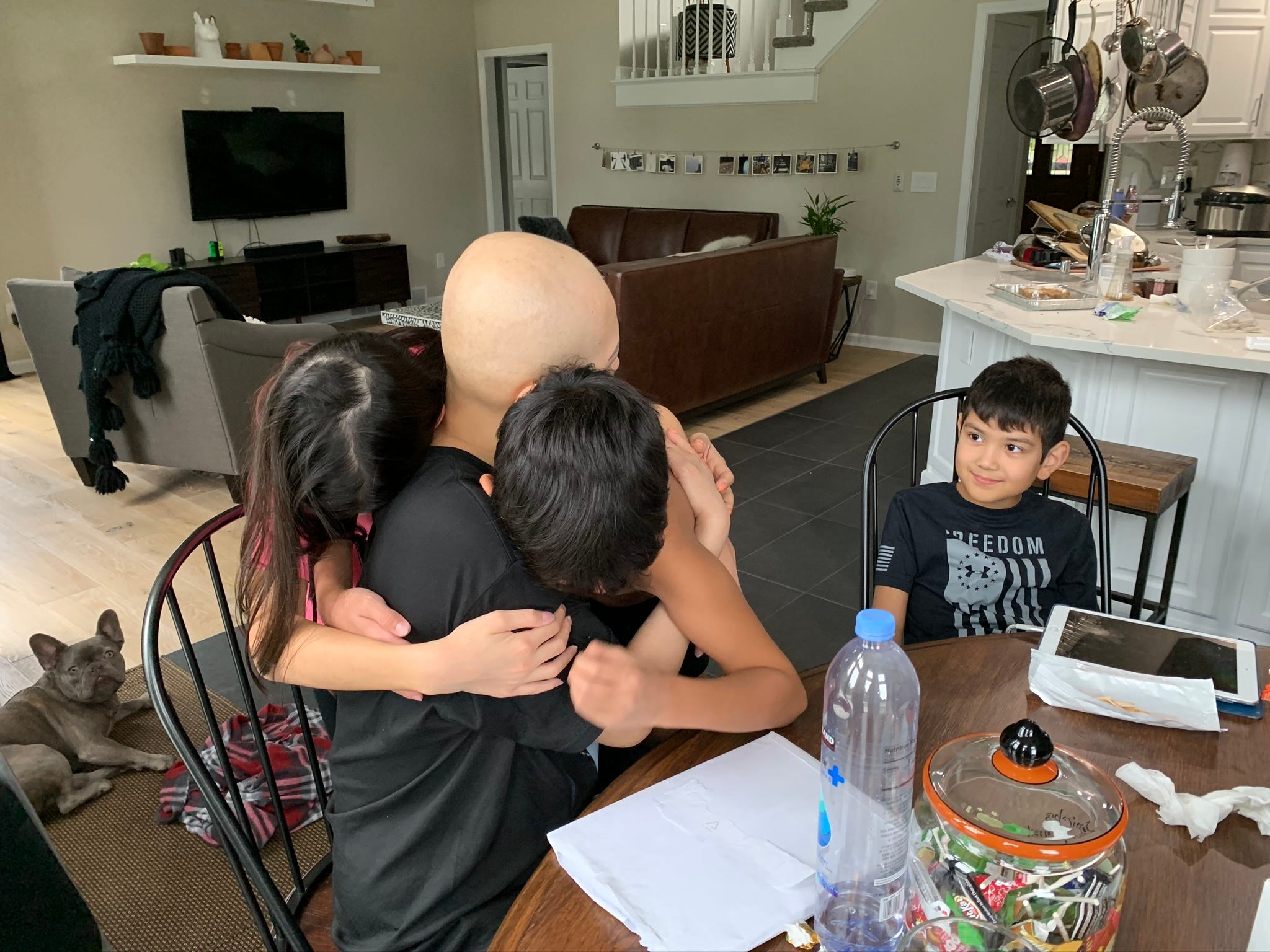
That night, we laid on the couch, wept, and held each other. The center of our world was leaving us.
When our eyes had gone dry, each person took to their place on the couch. We sat in stillness and watched a movie.
I could not focus on anything but watching my family of five start wrestling with the truth that we would soon be a family of four.
The hardest thing I’d ever had to do was tell my kids that their mother was going to die.
Or so I thought.
One Breath Changed Everything
Watching Ariana take her last breath on September 30, 2020 at 11:08AM became the hardest thing I ever had to do.
I watched my world crumble in the span of a single breath not taken.
I saw my children collapse.
I felt like I had lost everything.
The first night, late into the evening, I tucked the kids into my bed. Turned on the TV.
I didn’t know what to say, so I just told them, “This isn’t fair. It is painful. Whatever you are feeling is okay. We will get through it together. I love you.”
I kissed each one goodnight and left them to sleep while I went downstairs to a frightening silence and bone crushing emptiness in the house.
This continued for the next several years.
I was not me. I was merely a shell of flesh and bone with one purpose: keep the kids alive.
Every morning I woke up to the same day. Feed the kids. Get them to where they need to be. Go to work. Do chores. Don’t die.
Breathing was no longer a subconscious process. I had to actively remember to breathe.
Every night I would get ready, pretending I was going to sleep. I would stare at myself in the mirror.
My eyes were dark and lifeless.
My hair fading from black to white.
My skin dry, dull and increasingly wrinkly.
I was...old.
Each white hair or new wrinkle became my battle scars of the stress and aging of watching your partner slowly die for six years.
But I did not feel pride for them. I was in anguish.
I felt unlovable, unworthy and the voices of my youth began again: “You’re disgusting. You’re nothing. You’re gross.”
I felt truly broken. In my mind, body, and spirit.
Despite all of it, there was a quiet whisper that told me to keep fighting for my life and future.
Grief Was Winning Until I Stopped Fighting
As the days went on, I began learning that grief was my own private event.
I encountered situations that confirmed to me that others didn’t want to actually hear how I was doing. They simply wanted me back to who I was before Ariana died.
It felt like I became the uncomfortable reminder of what could happen to them.
So I sought out places where I was allowed to grieve.
Therapists, coaches, selective friends and family. It took work and effort to find those safe spaces.
A lot of effort.
But I was determined to confront my grief. To step into the abyss, find the reserves of strength needed, and step out changed.
The first step was changing my beliefs of my worthiness, or lack thereof. Which meant learning who I was now. My identity. My habits. My hobbies. My likes and dislikes. My values.
Everything was on the table. It was all new and yet discovered.
I had to begin to see myself for the intrinsic worth I had and not focus on all the externals that I lacked.
Each day brought new physical torment. My chest felt like it was caving in. My stomach twisted into knots. I would wake up with my jaw clenched so tight my teeth ached.
I had to grow comfortable with the pain or else I would not survive the summit.
It took years.
Many mistakes.
Many failures.
A lot of shame.
But slowly progress was being made.
My bones began to heal. Skin grew around the muscles that were beginning to take shape.
I grieved the man I used to be. The man who died with Ariana and I started experimenting with new hobbies, interests, worldviews, and ideas.
I talked to others about their journeys with grief. I learned as much as I could.
Critically, I pushed myself harder than was necessary or even healthy.
But I was determined to heal. Mostly, I was desperate to escape my hell.
After years of endurance, I collapsed. My body and mind had enough.
I hit bottom.
The brokenness was still there, but hidden away, covered under the “sadness.”
I realized I was not in control. My grief was.
And I had spent too much time fighting for control in a battle that I was never going to win.
So I gave it up. Slowed down and listened to what my grief was saying.
Once I became quiet enough, I finally heard its whispers and it was one word, “anger.”
I resisted. Convinced I wasn’t angry. When in reality, I was too scared to admit that I was.
I was afraid of it.
Afraid of what it said about me.
Afraid of what I might do.
Afraid it confirmed everything ever said to me, “I was disgusting.”
Then, one morning, I found myself in a dark room. Hands grasped around handle bars. Feet snapped into the pedals.
The instructor yelling at us to dig deeper and push.
So I pedaled faster. My legs burned. My heart beating in my throat. And before my body gave out, the anger flooded.
I let my head fall and began screaming into my chest. Hiding what was happening from the rest of the class.
“I hate you, Ariana, for leaving me. I hate that my kids lost their mom. I hate that no one understands me. I hate every horrible and misguided word said to me.” I cried out.
My legs pushing harder now. I kept repeating my anger fueled mantra.
The anger turned to tears. Tears to acceptance.
Acceptance to the beginning of true healing.
When the Job Title Dies With Her
Part of the process of healing was learning to grieve the career that I had left behind.
It wasn’t the loss of the job, it was the loss of identity as the “smart, high earning, engineer.”
Now I was just a meme. The guy who “left his high paying job to become a solopreneur.”
I carried shame into every conversation I had about work. When introducing myself, “former silicon valley engineer” was always caveated before bringing up the work I was doing in grief.
I felt like an imposter. A fraud. Like I’d thrown away everything I’d built because I was too broken to keep going. I had given up stability and respect for something intangible that might never pay the bills.
I was proving everyone right who ever called me worthless.
My stomach would tighten, a knot forming just below my ribs. My teeth grinding. The voice in my head: “You’re wasting your life. You had something real and you walked away from it. Who are you to think you can help anyone when you can’t even help yourself?”
Whenever I hit a roadblock, or started to panic, I would start looking up tech jobs. A compulsive behavior to drown out the fear.
But after a few days, that internal drive would overwhelm the fear. The belief that this isn’t the work I want to be doing, it is the work that I have to be doing.
Working in the grief space was not a job. It was a calling in the truest sense of the word.
And the stronger the calling became, the further removed I was from the identity of “engineer.”
With one side effect: my ambition was no longer driven by the need to prove my worth, but it was driven for the love of the work itself and the service of others.
To help people navigate their grief, identity, and gain mastery of their inner world so they can find a future.
The Work That Had to Be Done
It is a lofty mission, I know, and a “future” that is impossible to think about when it was just ripped from you.
If someone told me I had a future while I was deep in my grief, I would have painted on a smile, called them an as*hole in my head, and walked away.
It was unfathomable. It was hateful to everything Ariana had suffered.
Much of my growth has come from running my companies, Unvoiced, Growth in Grief, and Hopeless Mope. Learning to heal my own grief while helping others process theirs, were lessons learned in the trenches.
So, as I began to write a new chapter in my professional journey, I decided to take on a new role as a resilience and grief coach. Which also created a new identity crisis that I needed to manage.
I had to accept that this is where my work was leading me.
I didn’t see myself as a coach, even though I was already doing in my life. Getting to work 1-on-1 with people and helping them navigate their grief, validate what they are feeling, and make small steps towards their future is the most rewarding and fulfilling work I could be engaged in.
It is part of why I write.
But it took time engaged in self-reflection to settle into this new view of myself.
To embrace what felt cringeworthy and ignore the judgments of “others” (my inner critic).
After four decades on earth, I have seen time and time again how critical our view of ourselves is, how much we tie it to the wrong things, and how easily it can be lost.
It is absolutely an integral part of our human experience to have the skills and help in discovering our identity, especially as it changes throughout each stage of our lives.
I am excited to help others master their emotional landscape, find color in the world again, and hold space while they endure the pain of inner work.
Identity isn’t found in the wreckage. It’s forged from it.
With love,
- CJ
P.S. If you’re deep in your grief and the idea of a “future” feels impossible right now, I get it. I work 1-on-1 with people navigating this exact terrain—the identity loss, the anger you’re afraid to name, the slow rebuild of a life you never wanted. It’s hard, long-term work, but it’s the work that changes everything.
I’ve created a free course to help you begin to build your identity.
If you enjoyed this read, the best compliment I could receive would be if you shared it with one person or restacked it.
Thank you CJ. Thank you for being vulnerable and yet still taking the time to share and help others by sharing your story!!!! I hope I can find my identity through my wreckage.